Views: 0 Author: Site Editor Publish Time: 2026-08-27 Origin: Site
The shift in nonwoven manufacturing from commodity production to highly engineered textiles is driven by strict medical, automotive, and industrial standards. Standard synthetic fibers force manufacturers to compromise between structural integrity—like high tensile strength and abrasion resistance—and specialized performance, such as moisture management, safety compliance, or tactile softness. You cannot afford product failures in high-stakes environments. Relying on traditional materials limits technical capabilities on the production floor.
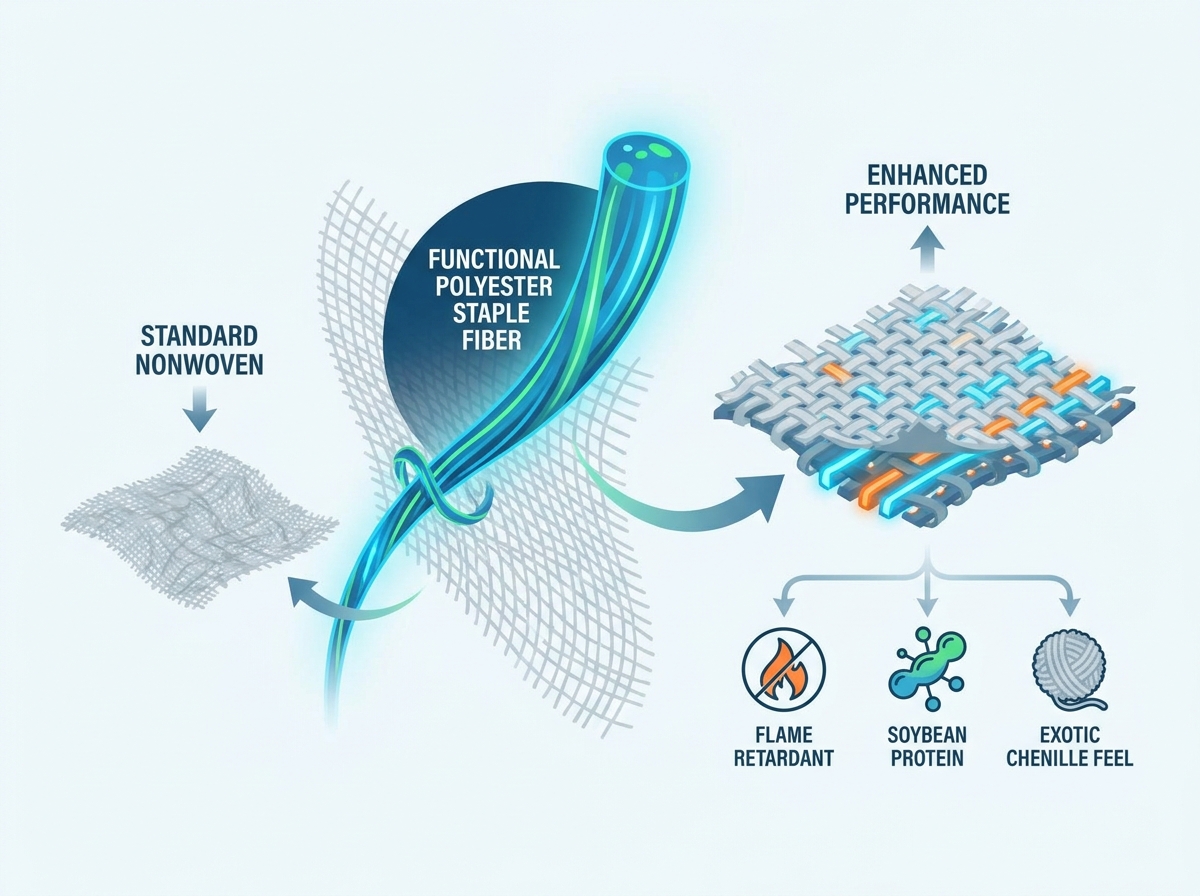
Engineering textiles at the polymer and fiber level solves this exact problem. Integrating Functional Polyester Staple Fiber allows manufacturers to meet strict success criteria directly during web formation. You achieve permanent moisture management, quick drying, and inherent safety compliance without relying on expensive, temporary post-finishing treatments. This approach alters the fundamental mechanics of the nonwoven fabric, establishing a superior baseline for downstream processing and final product performance.
Performance Engineering: Functional polyester staple fiber directly alters web cohesion, fabric cover, and pilling resistance, establishing a superior baseline for nonwoven mechanics and industrial fabrics.
Targeted Compliance: Variants like flame retardant polyester fiber eliminate the need for topical chemical treatments, ensuring permanent regulatory compliance in automotive and upholstery applications.
Advanced Blending: Integrating specialized fibers, such as soybean protein polyester fiber, bridges the gap between synthetic durability and natural fiber comfort for hygiene and medical nonwovens.
Manufacturing Realities: Successful implementation requires evaluating denier distribution (including ultrafine options), thermal behavior, and processing compatibility across spunlace, needle punch, or thermal bonding lines.
High-performance nonwovens demand a strict baseline of mechanical properties. You must achieve high tensile strength, exceptional abrasion resistance, and predictable dimensional stability across both consumer and industrial fabrics. Standard fibers often fail under extreme mechanical stress or repeated washing. When you push a standard nonwoven fabric through aggressive processing or subject it to harsh end-use environments, the material degrades. Fibers shed, webs break, and the fabric loses its structural integrity.
Defining your success criteria means setting measurable thresholds for tear resistance, elongation at break, and burst strength before selecting your raw materials. Factory floor realities dictate that if a fiber cannot survive the aggressive action of a cross-lapper or the high-pressure jets of a hydroentanglement manifold, it has no place in an engineered textile. You need materials that maintain their physical properties from the bale opener all the way through to the final roll winder.
Differentiating between standard solid-section polyester staple fiber (PSF) and functional PSF is the first step in material selection. Standard solid-section fibers provide basic bulk and moderate strength. They serve well in low-demand applications like basic geotextiles or cheap packaging liners. Functional fibers undergo engineering at the extrusion phase. Manufacturers alter the spinneret designs to create hollow, conjugated, or multi-lobal cross-sections.
They modify the polymer chemistry to introduce inherent properties directly into the molecular chain. You can select ultrafine or micro-denier fibers to increase surface area, or utilize bi-component fibers with differing melting points to facilitate advanced thermal bonding. These modifications directly target specific performance gaps in standard textiles. A hollow conjugated fiber, for instance, provides exceptional loft and recovery under compression, which a solid-section fiber simply cannot replicate regardless of how it is processed.
Understanding how functional fibers interact with mechanical, thermal, or chemical bonding processes dictates the efficiency of web formation. In mechanical bonding, such as needle punching, the crimp frequency and fiber finish determine how well the barbed needles entangle the web. High-crimp functional fibers lock together more securely. This reduces needle wear, minimizes punch density requirements, and increases overall fabric density. The barbs catch the engineered crimps efficiently, driving them through the Z-axis of the fabric to create a highly entangled matrix.
In thermal bonding, bi-component functional fibers utilize a low-melting sheath over a high-melting core. As the web passes through the heated calendar rollers, the sheath melts to form strong intersectional bonds while the core maintains the fabric's tensile strength. You control the exact stiffness and drape of the fabric by adjusting the calendar temperature and nip pressure. Chemical bonding relies on resin penetration, where specific functional fiber finishes can either repel or absorb the binder based on your application needs, altering the final hand-feel and rigidity of the nonwoven.
Functional fibers improve downstream textile products through optimized bimodal denier distribution. Mixing different deniers—such as blending coarse 6.0 denier fibers for structure with ultrafine 1.2 denier fibers for density—optimizes the packing fraction of the web. The fine fibers fill the interstitial spaces between the coarse fibers. This increases the total number of fiber-to-fiber contact points within a given square meter of fabric.
More contact points generate higher yarn cohesion and superior overall fabric cover. This structural density significantly enhances pilling resistance. Individual fibers remain tightly anchored within the matrix, preventing them from migrating to the surface during abrasion. When you engineer the denier distribution correctly, you achieve a smoother surface profile, better printability for secondary processing, and a more uniform distribution of functional properties across the entire web.
Safety compliance in industrial and automotive sectors leaves no room for error. Evaluating flame retardant polyester fiber requires analyzing permanent versus topical flame retardancy. Topical chemical treatments degrade over time. They wash out, wear off, and often fail long-term Limiting Oxygen Index (LOI) specifications. Many topical treatments struggle to meet strict toxicity compliance standards like REACH and RoHS, creating liability issues for manufacturers.
Inherent flame retardancy solves this by integrating phosphorus-based or other flame-retardant comonomers directly during polymerization. The flame resistance becomes part of the molecular structure. When exposed to heat, these fibers promote char formation rather than melting and dripping. This mechanism cuts off the oxygen supply to the flame. The fabric maintains its safety ratings even after extensive mechanical wear or repeated washing. You secure permanent compliance for automotive headliners, engine compartment insulators, and commercial upholstery without adding secondary wet processing steps to your production line.
Hygiene and medical nonwovens require a delicate balance. You need the structural durability of synthetics combined with the skin-contact safety and moisture management of natural fibers. Traditional post-finishing attempts to add hydrophilic properties to standard polyester, but these finishes wash away and can cause skin irritation during prolonged contact. Evaluating soybean protein polyester fiber focuses on permanent moisture management, quick-drying capabilities, and biocompatibility.
The manufacturing process grafts soybean protein directly onto the polyester backbone. This introduces natural amino acids to the synthetic fiber. The result is a fiber that provides the softness, fluffiness, and health protection required for high-cleanness nonwoven spunlace. The protein sites attract and manage moisture, pulling it away from the skin, while the polyester core ensures rapid evaporation and quick drying. You achieve permanent moisture management without sacrificing the high tensile strength and synthetic durability required for medical wipes, surgical gowns, and premium hygiene products running on high-speed spunlace lines.
Specialty nonwovens often require unique aesthetic enhancements and tactile properties. While exotic polyester fiber for chenille yarn is traditionally utilized in woven or knitted decorative textiles, its physical characteristics translate exceptionally well to nonwoven engineering. You evaluate these fibers based on their cross-over application viability and structural geometry.
These exotic fibers feature high-crimp profiles and unique cross-sectional shapes, such as deep grooves or multi-lobal structures. When introduced into specialty high-loft nonwovens, these geometries prevent the fibers from packing too tightly. They trap significant volumes of air within the web matrix. This improves the overall bulk and resilience of the fabric. The trapped air acts as an excellent sound barrier, making these fibers highly effective for acoustic insulation panels in automotive and architectural applications. You gain structural loft and enhanced tactile properties without increasing the total weight of the nonwoven fabric, optimizing your material yield.
The foundation of any nonwoven fabric is the integrity of the initial web. Specific fiber finishes, ultrafine deniers, and engineered crimp profiles directly dictate how the fibers behave on the carding machine. Standard fibers with inadequate spin finish generate static electricity. They wrap around the lickerin or cylinder, causing web breakage, neps, and uneven fabric weight. This leads to massive downtime and material waste on the factory floor.
functional polyester staple fiber utilizes precisely formulated antistatic finishes that control fiber-to-metal friction. This ensures smooth transfer through the carding elements and efficient removal by the doffer. The engineered crimp profiles enhance mechanical interlocking. When the web enters the needle loom, the barbed needles catch the crimped fibers more effectively, driving them through the Z-axis of the fabric. This creates a tightly bound, high-strength matrix that resists delamination and tearing under load, even at lower punch densities.
High-cleanness applications rely heavily on the spunlace, or hydroentanglement, process. This method uses high-pressure water jets to entangle the fibers. Evaluating the interaction between these water jets and functional fibers determines the final fabric quality. You must achieve optimal softness and tensile strength without causing fiber shedding. The water pressure profiles must match the fiber's bending rigidity.
Ultrafine functional fibers excel in this environment. Their low bending rigidity allows the water jets to easily manipulate and knot the fibers together. Because the fibers are engineered for high tenacity, they withstand the aggressive hydraulic forces without fracturing. This prevents short fiber segments from shedding into the final product. Keeping shed fibers out of the water filtration system reduces maintenance downtime and ensures the fabric meets the strict particulate limits required for medical and cleanroom environments.
Pure synthetic webs do not always meet complex end-use requirements. The technical realities of blending functional polyester staple fiber with natural fibers—such as cotton, wool, or viscose—require precise engineering. You blend these materials to dramatically improve fabric performance, maximize longevity, and balance production costs. The challenge lies in managing different staple lengths, crimp levels, and moisture regains during the opening and blending stages.
Functional fibers can be cut to specific lengths to match the natural fiber profile. This prevents nep formation during opening and carding. The synthetic component adds tensile strength, abrasion resistance, and dimensional stability, while the natural component provides breathability and fluid absorption. Mastering these blending dynamics allows you to engineer hybrid nonwovens that outperform single-fiber fabrics in almost every metric. You must calibrate your weigh pans and blending bins accurately to ensure a homogeneous mix before the material hits the card chute.
Performance Metrics Across Fiber Types
Fiber Category | Tensile Strength Retention | Moisture Management | Flame Resistance | Primary Nonwoven Application |
|---|---|---|---|---|
Standard Solid-Section PSF | Moderate | Low (Hydrophobic) | Poor (Melts/Drips) | Basic Geotextiles, Low-end Fill |
Flame Retardant Functional PSF | High | Low | Excellent (Inherent LOI >28) | Automotive Insulation, Filtration |
Protein-Grafted Functional PSF | High | Excellent (Hydrophilic Sites) | Poor | Medical Spunlace, Hygiene Wipes |
High-Crimp Exotic PSF | Moderate | Moderate | Poor | Acoustic Panels, High-Loft Insulation |
Transitioning to functional fibers involves conceptual trade-offs on the production line. You balance the higher initial procurement cost of functional PSF against the downstream manufacturing efficiencies. Standard fibers require secondary chemical finishing processes to achieve specialized traits. These wet processes consume massive amounts of water, require energy-intensive drying ovens, and introduce environmental compliance challenges regarding wastewater discharge.
Functional fibers eliminate these secondary steps. The performance is built into the raw material. The inherent properties of functional fibers reduce product failure rates in the field. Fabrics do not lose their flame resistance or moisture management after washing or heavy abrasion. You streamline your production line, reduce chemical inventory, free up floor space previously used for drying equipment, and deliver a more reliable product to the end user.
Scaling production with new raw materials introduces specific processing failures. Static buildup during carding remains a primary risk if the environmental humidity does not match the fiber's spin finish requirements. Dry factory conditions will cause the fibers to fly and wrap around rotating cylinders. Uneven blending of multi-denier fibers causes weak spots in the web, leading to unpredictable tensile strength in the final fabric.
Thermal shrinkage variations during bonding present another significant risk. If you blend a functional fiber with a high thermal shrinkage rate alongside a stable natural fiber, the resulting fabric will pucker, warp, and lose dimensional stability as it passes through the heated calendar rollers. This differential shrinkage ruins the aesthetic and structural integrity of the roll, leading to immediate rejection during quality control inspections.
You mitigate these risks through strict process control and supplier verification. Adjust your machine settings before running commercial volumes to accommodate the new fiber profiles.
Lower your carding speeds initially to monitor web uniformity and static generation.
Adjust your thermal calendar temperatures to match the specific melting point or shrinkage profile of the functional fiber.
Require strict Technical Data Sheet (TDS) verification from your fiber supplier for every batch.
Verify the exact spin finish levels, staple length variance, and crimp frequency before loading the bale opener.
Conduct small-scale pilot runs to test fiber-to-metal friction and blending homogeneity before committing your main production lines.
Request 50kg fiber samples of specific functional variants to run isolated carding and blending tests on your pilot lines.
Evaluate web uniformity under light transmission to identify any nep formation or uneven denier distribution during the initial carding phase.
Conduct standardized testing, including ASTM D5034 for tensile strength and ASTM D6413 for flammability, on the pilot fabrics to verify performance claims.
Calibrate your thermal calendar temperatures and hydroentanglement water pressures to match the specific thermal and bending properties of the new fiber blend.
A: Functional polyester staple fiber is a synthetic fiber engineered at the polymer level or through unique cross-sections to provide specific performance traits—such as moisture management, flame resistance, or enhanced softness—beyond standard polyester.
A: Functional PSF integrates properties like moisture management, quick drying, and flame retardancy at the polymer level, making them permanent. Post-finishing treatments are applied to the fabric surface and often degrade after washing or mechanical wear.
A: It incorporates flame-resistant properties directly into the molecular structure of the fiber, ensuring permanent compliance with fire safety standards without relying on chemical coatings that can degrade over time.
A: Due to its exceptional softness, skin-friendly nature, and inherent quick-drying capabilities, it is highly valued in high-cleanness nonwoven spunlace used for medical textiles, wipes, and hygiene products.
A: Yes. The unique high-crimp and specialized cross-sections of exotic polyester fibers, typically used for decorative chenille yarns, are increasingly blended into specialty nonwovens to enhance loft, bulk, and acoustic properties.
A: A controlled, bimodal denier distribution optimizes the packing density of the fibers, which improves web cohesion, enhances fabric cover, and significantly increases pilling resistance in the final textile product.
A: The primary risks include uneven fiber distribution during carding due to differing staple lengths and crimp levels, as well as static electricity buildup, which can be mitigated by optimizing the spin finish and environmental humidity controls.