Views: 0 Author: Site Editor Publish Time: 2026-08-14 Origin: Site
Industrial textile manufacturing is rapidly shifting away from traditional chemical binders. Factory floors require cleaner, heat-activated bonding methods to maintain high production speeds while meeting strict environmental compliance standards. Plant managers face a constant balancing act: ensuring structural fabric integrity without slowing down the line or failing VOC emissions tests. Low Melt Polyester Staple Fiber solves this operational bottleneck. Engineered as a structural adhesive embedded directly within the material matrix, it enables efficient thermal bonding without compromising fabric performance. By eliminating liquid resins, facilities bypass lengthy curing times and hazardous off-gassing. This guide breaks down the mechanics of bi-component fibers, details the thermal bonding process, and provides actionable parameters for optimizing blend ratios in industrial nonwoven applications.
Bi-Component Engineering: Low melt fibers utilize a sheath-core structure where the outer sheath melts at lower temperatures (120–140°C) while the core maintains structural stability.
Chemical Elimination: Thermal bonding with these fibers completely removes the need for liquid adhesives, resins, and the associated curing times or VOC emissions.
Customizable Performance: Adjusting the blend ratio of low melt fibers directly controls the rigidity, loft, tensile strength, and moldability of the final nonwoven product.
Production Efficiency: Transitioning to thermal bonding reduces energy consumption associated with drying chemical binders and accelerates overall line speeds.
The physical composition of this fiber relies on advanced bi-component extrusion technology. During manufacturing, spinnerets extrude two distinct polymers simultaneously to form a single filament. The inner core consists of standard polyethylene terephthalate (PET). This core provides the primary tensile strength, crimp retention, and structural backbone of the fiber. The outer sheath consists of a modified co-polyester engineered specifically to act as the active bonding agent.
The sheath completely encapsulates the core in a concentric configuration. This geometry ensures uniform adhesive distribution along the entire length of the fiber. When the web passes through a heat source, only the sheath undergoes a phase change. The core remains completely solid. This selective melting prevents the nonwoven web from collapsing, shrinking excessively, or losing its dimensional stability under tension.
Table: Bi-Component Fiber Specifications
Component | Material Composition | Primary Function | Phase Behavior During Heating |
|---|---|---|---|
Outer Sheath | Modified Co-Polyester | Bonding agent / Adhesive | Melts and flows to intersection points |
Inner Core | Standard PET | Tensile strength / Loft support | Remains solid and structurally intact |
The melting threshold for the modified co-polyester sheath sits strictly between 120°C and 140°C. This specific temperature range aligns perfectly with standard industrial thermal ovens. The thermodynamic phase change occurs rapidly once the fiber reaches this target temperature. The sheath transitions from a solid state into a highly viscous liquid. Capillary action then draws this liquid toward the nearest fiber intersections.
The standard PET core has a much higher melting point of approximately 250°C. This massive temperature differential allows operators to aggressively heat the nonwoven web without damaging the primary polyester matrix. The 120–140°C window provides a wide enough margin to account for minor temperature fluctuations and uneven airflow inside industrial ovens, ensuring consistent bonding without risking core degradation.
Fiber thickness and length directly dictate blending behavior, mechanical entanglement, and final fabric density. Manufacturers select these dimensions based on the desired rigidity and surface smoothness of the final product. Standard dimensions often include specifications like 4D x 51mm.
2D (Denier): Creates softer, denser fabrics with a smoother surface finish. Often used in apparel insulation and fine filtration media.
4D (Denier): The industry standard for general-purpose batting, offering a balance of softness and structural resilience.
6D to 15D (Denier): Produces stiffer, highly porous materials with maximum loft. Used heavily in automotive acoustics and mattress cores.
32mm to 38mm (Cut Length): Blends rapidly but offers less mechanical entanglement. Ideal for high-speed carding lines producing lightweight webs.
51mm to 64mm (Cut Length): Provides superior structural interlocking. Requires precise carding machine adjustments to prevent clumping and neps.
The thermal bonding process begins in the opening room. Operators feed raw bales of fiber into bale openers and coarse blending machines. The bi-component fibers are mixed thoroughly with base materials. This base material is typically standard polyester staple fiber for nonwoven fabrics. The modified sheath bonds effectively with natural fibers like cotton or wool, and fuses seamlessly with other synthetic materials to create specialized hybrid fabrics.
Uniform distribution during this stage dictates the success of the entire run. Fine openers separate the fiber tufts before sending them to the carding machine. The carding cylinder combs the blended fibers into a parallel, uniform web. Cross-lappers then layer this web back and forth onto a conveyor to achieve the target basis weight and thickness. Any inconsistency in blending at this stage will result in weak spots, delamination, or rigid clumps in the final fabric.
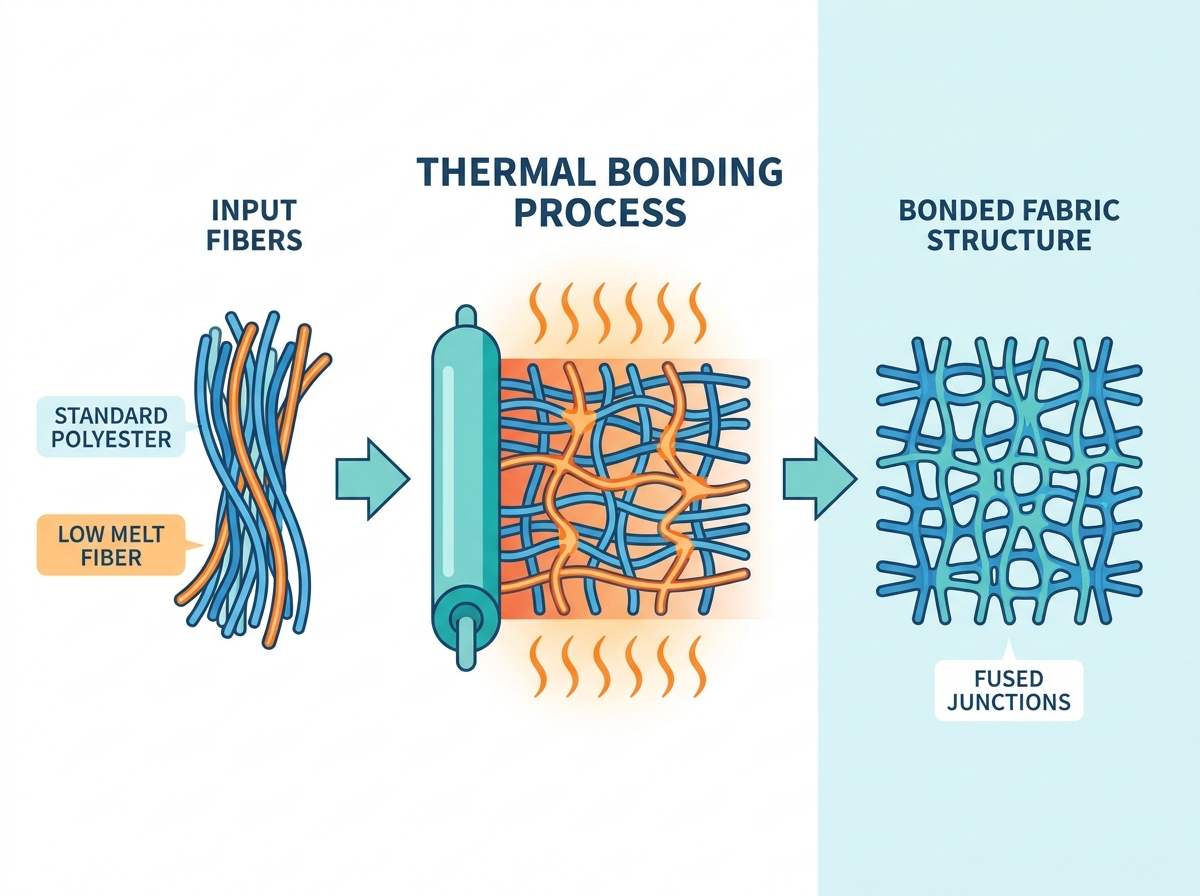
The layered fiber web enters the thermal bonding oven. Industrial facilities use either convective hot air ovens or conductive heated calendar rolls depending on the desired fabric density.
Pre-Heating Zone: The web enters the oven and the ambient temperature ramps up quickly. Moisture flashes off the fibers.
Activation Zone: The internal temperature hits the 120–140°C threshold. The outer sheath melts. Convective ovens force hot air directly through the porous web, which is ideal for high-loft batting. Conductive calendering presses the web between heated steel rollers, producing flat, dense fabrics.
Dwell and Bonding Zone: The web remains at the target temperature just long enough for capillary action to draw the viscous liquid polymer toward the intersection points of the fibers. The melted sheath wraps around the solid cores of adjacent fibers.
The web exits the heating zone and immediately enters a cooling section. Rapid temperature reduction sets the bonds permanently. High-velocity ambient or chilled air blows across the fabric, dropping the temperature below the sheath's glass transition point. The melted co-polyester solidifies rapidly, creating permanent, three-dimensional weld points across the entire nonwoven matrix.
These weld points lock the fibers into a stable geometric structure. Rapid cooling prevents the polymer from continuing to flow, which would otherwise cause the fabric to become overly stiff or lose its designed porosity. The final product emerges as a highly stable, uniform fabric ready for immediate slitting, winding, and packaging.
Thermally bonded matrices offer superior physical durability compared to chemically bonded equivalents. Chemical adhesives, such as acrylics or SBR latex, coat the entire fiber network. This continuous coating makes the final fabric brittle over time and restricts the natural flexibility of the base fibers. Thermal bonding targets only the intersection points.
This point-bonding method preserves the natural flexibility and loft of the web. Thermally bonded fabrics retain their shape and resist flattening under continuous compression. They exhibit excellent tensile and tear strength because the bi-component sheath physically welds the structural cores together. The resulting fabric withstands repeated mechanical stress without shedding dried adhesive particles.
Eliminating chemical resins provides massive regulatory advantages for plant operators. Traditional chemical binders often contain formaldehyde and other volatile organic compounds (VOCs). These chemicals require strict ventilation, continuous environmental monitoring, and hazardous waste disposal protocols. Thermal bonding produces zero formaldehyde emissions.
It completely removes liquid adhesives from the facility, eliminating the wastewater generated from washing out mixing tanks, pipes, and application equipment. Furthermore, fabrics made entirely from standard PET and low melt polyester staple fiber are highly recyclable. Because no foreign chemical resins contaminate the matrix, the entire nonwoven product can be shredded, melted down, and re-extruded at the end of its lifecycle.
Transitioning to thermal bonding requires a clear operational analysis. Bi-component fibers carry a higher upfront procurement cost per kilogram than standard polyester fibers. However, the operational savings quickly offset this initial material expense. Facilities eliminate the continuous procurement, storage, and handling of liquid adhesives.
The most significant savings come from energy reduction. Chemical binders require massive, high-energy drying ovens to evaporate water and cure the resin. Thermal bonding requires significantly less energy. The ovens only need to reach 120–140°C to melt the sheath, with no water to evaporate. This lower thermal requirement reduces utility bills and accelerates overall production line speeds.
Table: Comparison of Thermal Bonding vs. Chemical Adhesives
Operational Metric | Thermal Bonding (Bi-Component Fiber) | Chemical Bonding (Liquid Resins) |
|---|---|---|
Bonding Mechanism | Modified co-polyester sheath melting | Water-based or solvent-based resin curing |
Energy Consumption | Low (Heating to 120-140°C) | High (Evaporating water/solvents at high heat) |
VOC Emissions | Zero | Moderate to High (Formaldehyde risks) |
Fabric Flexibility | High (Point-bonded intersections) | Low (Coated fibers become brittle) |
End-of-Life Recyclability | 100% Recyclable (Pure polyester matrix) | Difficult (Contaminated by chemical binders) |
Line Speed | Fast (Rapid melting and cooling) | Slower (Requires extended dwell time for curing) |
The three-dimensional bonded matrix traps air highly efficiently. This makes it an ideal material for automotive insulation and architectural acoustic panels. In the automotive sector, manufacturers use these fabrics for noise, vibration, and harshness (NVH) mitigation in door panels, headliners, and dash insulators. The thermally bonded structure absorbs sound waves and blocks heat transfer from the engine bay. The absence of chemical binders ensures no toxic off-gassing occurs inside the vehicle cabin under high summer temperatures. Architectural panels utilize the same properties to improve room acoustics. The structural stability of the weld points prevents the insulation from sagging inside vertical wall cavities over decades of use.
The thermal bonding matrix can be reheated and pressed into rigid, three-dimensional shapes. Manufacturers utilize thermal bonding polyester fiber to produce automotive trunk liners, interior wheel well liners, and structural packaging. When the flat fabric enters a heated mold, the co-polyester sheath melts a second time. The hydraulic press applies high tonnage, forcing the fibers into the exact geometry of the die. As the mold cools, the sheath solidifies, locking the fabric into a permanent rigid shape. This process creates lightweight, highly durable components that replace heavier injection-molded plastics.
Low melt fibers are standard for creating resilient, high-loft batting used in mattresses, sofas, and outdoor upholstery. Traditional batting flattens and loses its cushioning properties after repeated use. Thermally bonded batting resists this degradation. The weld points act like microscopic springs. When a person sits on the upholstery, the fibers compress. When the weight is removed, the welded intersections force the fibers back into their original position. This structural memory ensures mattresses maintain their loft and comfort. The lack of chemical adhesives also appeals to consumers seeking hypoallergenic bedding products.
Precise blend ratios allow manufacturers to control the exact porosity and structural stability of industrial filters. Air and liquid filtration media require consistent pore sizes to trap contaminants effectively. Thermal bonding locks the fibers in place, preventing them from shifting under high fluid pressure or heavy airflow. This stability ensures the filter maintains its designated MERV or micron rating throughout its operational life. In civil engineering, geotextiles use these fibers for ground stabilization, erosion control, and drainage. The thermally bonded fabric resists tearing under heavy soil loads while allowing water to pass through the controlled porous matrix.
Manufacturers must calculate the exact percentage of low melt fiber needed for their specific application. The blend ratio operates on a sliding scale of performance. Technical teams must evaluate the mechanical requirements of the final product before setting the blend ratio on the factory floor.
10% to 15% Blend: Maintains high loft, softness, and flexibility. Ideal for apparel insulation, lightweight furniture batting, and soft filtration media.
15% to 20% Blend: Provides medium rigidity and excellent tensile strength. Used for mattress cores, acoustic panels, and heavy-duty geotextiles.
20% to 30% Blend: Yields highly rigid, structural felts. Necessary for thermoformed automotive parts, stiff filtration boards, and molded packaging.
Procurement teams must rigorously evaluate suppliers to ensure consistent production quality. Consistency in the sheath melting point is the primary metric. Variations in the activation temperature will cause uneven bonding, leading to fabric delamination. Buyers should evaluate virgin versus recycled (rPET) core options. Recycled cores offer sustainability marketing benefits but require tighter quality control to monitor variations in tensile strength. Color consistency is another vital metric. Suppliers must provide exact color matching, such as standard raw white for medical bedding or deep black for automotive trunk liners. Transparent technical data sheets detailing crimp retention and finish oil percentages are mandatory for long-term partnerships.
Procurement departments must analyze the trade-offs between premium fiber costs and operational efficiency. The elimination of chemical mixing errors and uneven resin application improves the overall yield of first-quality fabric. Manufacturers eliminate secondary processing steps, such as washing or extended oven curing. The reduction in energy consumption, combined with higher line speeds and lower scrap rates, ultimately lowers the total cost of manufacturing per square meter of fabric. Less downtime for cleaning chemical nozzles directly translates to higher annual production volumes.
Improper oven temperature calibration presents a major production risk. Under-heating the web results in weak bonds. The sheath fails to melt completely, leading to fabric delamination and poor tensile strength. Over-heating the web degrades the standard polyester core. This causes the fabric to shrink, become brittle, or melt onto the Teflon conveyor belts. Operators must maintain precise thermal profiles across the entire width of the oven. Regular calibration of temperature sensors and airflow baffles is necessary. Thermal imaging cameras mounted at the oven exit help monitor the web temperature in real-time to prevent these defects.
Poor fiber mixing during the initial stages ruins the final product. Inconsistent blending causes the low melt fibers to clump together. This creates rigid, hard spots in the fabric while leaving other areas completely unbonded. Unbonded areas will tear easily under tension during the winding process. To mitigate this risk, operators must adjust mechanical carding parameters. Optimizing the speed of the worker and stripper rollers ensures complete separation and homogeneous mixing of the fibers. Routine visual inspections of the web before it enters the cross-lapper help identify blending issues early.
Raw low melt fibers require specific storage conditions to prevent premature fusing. Storing bales in high-heat environments, such as unventilated warehouses during summer, causes the outer sheaths to soften and stick together. This makes the bales impossible to open and blend properly on the fine openers. Excessive compression during transit can also damage the fiber crimp structure. Facilities must store these materials in temperature-controlled environments away from direct sunlight or heat sources. Inventory management should follow a strict first-in, first-out (FIFO) rotation to prevent long-term compression damage.
The transition to thermal bonding using engineered bi-component fibers represents a necessary upgrade for modern nonwoven manufacturers. Facilities prioritizing production speed, environmental compliance, and product quality must move away from chemical adhesives. Low melt fibers provide a clean, highly controllable, and structurally superior bonding method. The elimination of VOCs, reduced energy consumption, and improved fabric recyclability make this technology indispensable for the future of industrial textiles. Selecting the correct fiber specification requires evaluating denier, cut length, and activation temperature based on the specific end-use application.
To successfully integrate this technology into your production line, follow these next steps:
Audit your current thermal oven capabilities to ensure uniform airflow and precise temperature control between 120°C and 140°C.
Request 50kg sample bales of 4D and 6D bi-component fibers from qualified suppliers for initial pilot line testing.
Run physical stress tests on the thermally bonded prototypes to verify tensile strength, tear resistance, and loft retention against your current chemically bonded products.
Update standard operating procedures for the opening and carding lines to accommodate the new mechanical blending ratios.
A: The modified co-polyester outer sheath melts at a specific range between 120°C and 140°C. The inner standard polyester core maintains structural integrity because it has a much higher melting point of approximately 250°C. This differential allows for safe thermal bonding without degrading the primary fiber structure.
A: Thermal bonding uses heat to melt a built-in polymer sheath that fuses adjacent fibers directly at their intersection points. Chemical bonding requires applying external liquid resins or adhesives to the web, followed by high-energy drying and curing processes to set the bonds.
A: The ideal blend ratio varies from 10% to 30% depending on the application. Lower ratios (10-15%) are used for soft, high-loft products like furniture batting. Higher ratios (20-30%) are required for rigid, moldable products like automotive trunk liners and structural felts.
A: Yes, these fabrics are highly recyclable. Because the entire matrix consists of 100% polyester without any contaminating chemical adhesives or liquid resins, the material can be easily shredded, melted down, and re-extruded into new polyester products at the end of its lifecycle.
A: Common denier sizes include 2D, 4D, and 6D. Lower deniers like 2D create softer, denser, and smoother fabrics. Higher deniers like 6D or 15D are used to produce stiffer, more porous materials with high loft and strong structural resilience.
A: Thermal bonding maintains excellent breathability. Unlike chemical coatings that can film over and block the fabric's pores, thermal point-bonding only fuses the fibers at their microscopic intersections. This preserves the open, porous structure required for air and liquid filtration.
A: Yes, the melted co-polyester sheath acts as a highly effective adhesive that can bind with natural fibers like cotton, wool, and hemp. This allows manufacturers to create specialized hybrid nonwovens that combine the benefits of natural materials with synthetic structural stability.