Views: 0 Author: Site Editor Publish Time: 2026-08-10 Origin: Site
Regulatory and consumer pressures are forcing textile, non-woven, and industrial manufacturers to transition away from petroleum-based synthetics. Sourcing verifiable sustainable materials is now a core operational mandate. Manufacturers face a distinct challenge. They must meet aggressive Environmental, Social, and Governance (ESG) targets without compromising the tensile strength, durability, and processing efficiency provided by synthetic fibers. Navigating this transition requires a rigorous assessment of material alternatives. You need to ensure they meet exact production specifications.
Evaluating Polyester Staple Fiber involves analyzing the viability of shifting from virgin feedstocks to recycled alternatives. This transition demands a clear framework. We must assess true recyclability, measure the actual environmental footprint, and confirm production readiness. Plant managers and procurement teams must look beyond surface-level green claims. You have to understand the chemical and mechanical realities of integrating recycled polymers into existing spinning, carding, and extrusion lines.
Recyclability is Conditional: While technically recyclable, the eco-friendliness of polyester staple fiber depends heavily on whether the recycling process is mechanical or chemical, and if it operates in a closed-loop or open-loop system.
Regenerated vs. Virgin: Regenerated polyester staple fiber significantly reduces energy consumption, environmental pollution, and petroleum dependency compared to virgin polyester staple fiber, though feedstock quality dictates final structural integrity.
Performance Parity is Achievable: High-grade recycled variants offer near-identical performance metrics for textiles, home furnishings, and industrial applications, provided strict supplier vetting and quality controls are enforced.
Drop-In Compatibility: Premium regenerated fibers can typically be integrated into existing production lines without requiring expensive machinery retooling.
Verification is Mandatory: Claims of "eco-friendly" must be substantiated by third-party traceability certifications (e.g., Global Recycled Standard) to mitigate greenwashing risks in procurement.
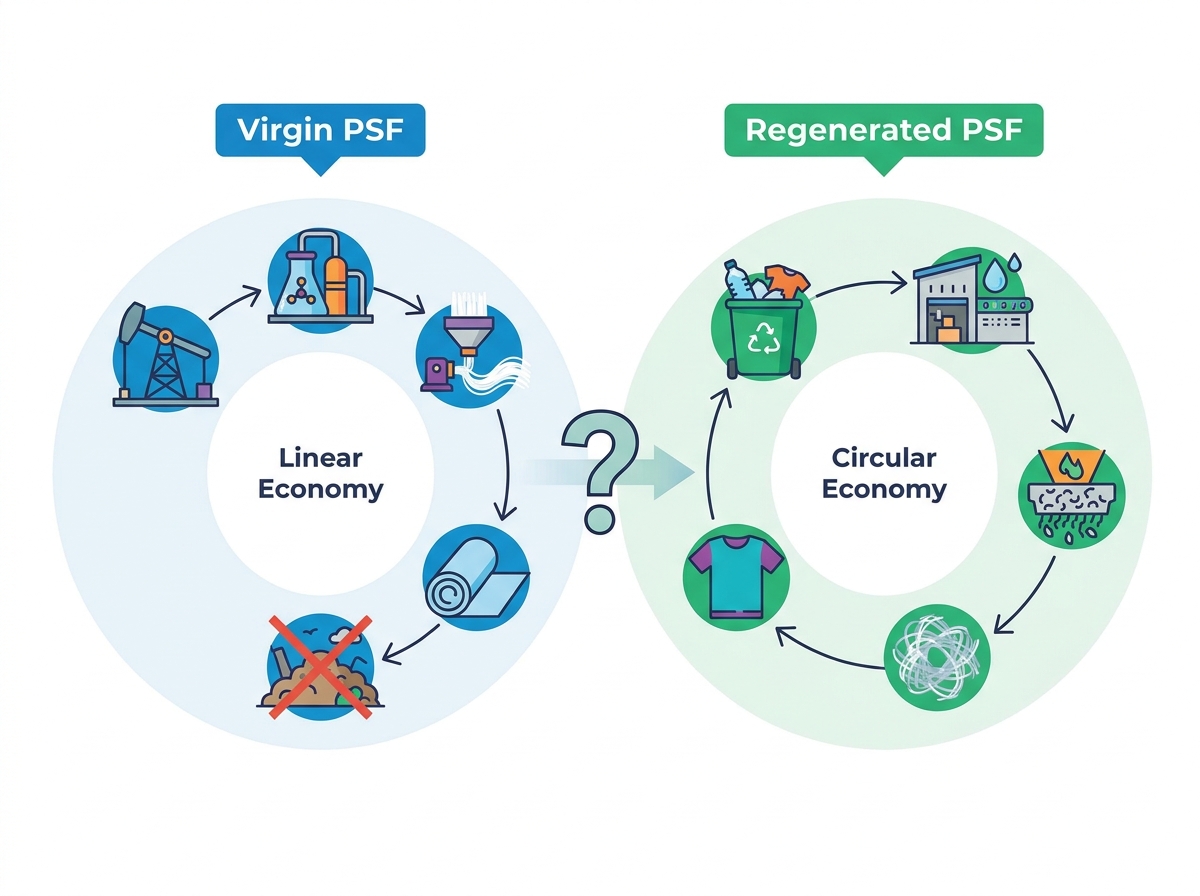
Establishing a baseline requires examining standard production methods. Producing virgin polyester staple fiber relies entirely on direct petrochemical extraction. The process synthesizes Purified Terephthalic Acid (PTA) and Monoethylene Glycol (MEG), both derived from crude oil refining. These chemicals undergo a polycondensation reaction at high temperatures in a vacuum. This creates polyethylene terephthalate (PET) melt. The melt is extruded through spinnerets, cooled, drawn, crimped, and cut into staple fibers. This method guarantees high structural consistency, predictable dye uptake, and maximum tensile strength. It also carries a massive environmental burden due to fossil fuel extraction and high energy demands.
Conversely, regenerated polyester staple fiber (rPSF) bypasses virgin petroleum feedstocks. It utilizes recycled PET waste. The origin of this waste dictates the final fiber quality. Post-consumer waste, primarily clear or light blue PET beverage bottles, represents the largest feedstock volume. This material requires rigorous sorting, hot washing, and decontamination to remove labels, adhesives, and organic residue. Post-industrial waste consists of factory offcuts, unspun polymer lumps, or rejected yarn. Post-industrial feedstocks generally offer higher baseline consistency and fewer contaminants because they have never entered the consumer waste stream.
Despite the different origins, the core chemical structure of virgin and regenerated PET remains equivalent. Both consist of the same repeating polymer chains. This chemical equivalence allows high-quality regenerated fibers to function interchangeably with virgin fibers in many production lines. The polymer can be melted and extruded through the same spinnerets. It maintains the physical characteristics required for downstream processing, provided the intrinsic viscosity (IV) of the recycled flake is high enough to withstand the spinning tension.
The industry relies on two primary methods to convert PET waste back into usable fiber: mechanical recycling and chemical recycling. Mechanical recycling dominates the current landscape due to lower operational costs and established infrastructure. The process follows a strict sequence to ensure polymer purity.
Bale Breaking and Sorting: Baled PET bottles are broken apart and separated by color and material type. Facilities use Near-Infrared (NIR) optical scanners to eject non-PET plastics like PVC or PETG.
Grinding: The sorted bottles are ground into uniform flakes, typically 10mm to 12mm in size.
Sink-Float Separation: Flakes enter a water bath. PET has a density of 1.38 g/cm³, causing it to sink. Polyolefin bottle caps and rings (HDPE/PP) have a density below 1.0 g/cm³ and float to the top for removal.
Hot Washing: The PET flakes undergo a caustic hot wash using sodium hydroxide (NaOH) at 85°C. This strips away EVA glues, paper labels, and residual sugars.
Drying and Extrusion: The clean flakes are dried to a moisture content below 1%. They are melted, passed through fine mesh screen changers to filter out unmelted particles, and extruded into continuous filaments.
Mechanical recycling has distinct limitations. The melting process subjects the polymer to thermal and shear stress. This shortens the molecular chains and reduces the intrinsic viscosity of the material. Over multiple recycling loops, this degradation compromises the fiber's tensile strength. Plant engineers must carefully monitor the IV drop during extrusion to prevent fiber breakage on the spinning line.
Chemical recycling addresses this degradation. It breaks the PET polymer down into its original monomer components through processes like glycolysis or methanolysis. Once separated and purified, these monomers are synthesized back into a new polymer. This method resets the material. It allows the polymer to maintain virgin-equivalent quality over multiple lifecycles. Chemical recycling currently holds a smaller market share due to high energy requirements, complex facility engineering, and significant capital investment.
Evaluating sustainability claims requires distinguishing between open-loop and closed-loop recycling. Skepticism surrounding synthetic fibers stems from the reality of open-loop systems. Currently, the vast majority of PET recycling is open-loop downcycling. Plastic bottles are converted into apparel, carpets, or fiberfill. Once these secondary products reach the end of their usable life, they are rarely recycled again. They typically end up in landfills or incinerators. This process delays disposal rather than preventing it.
The industry is actively pursuing textile-to-textile closed-loop recycling to solve this issue. Emerging technologies and pilot programs focus on taking discarded polyester garments and chemically recycling them back into new fiber. Achieving a true closed loop decouples textile production from both virgin petroleum extraction and the beverage industry's plastic waste stream. It creates a self-sustaining material ecosystem for manufacturers.
Implementing closed-loop systems faces severe infrastructure realities. There is a distinct lack of standardized global collection networks for discarded textiles. Municipal recycling programs handle rigid plastics efficiently. Textile recovery relies on fragmented donation systems and private sorting facilities. These facilities lack the automated capacity to process material at an industrial scale.
Recycling becomes exponentially more difficult when synthetic fibers are mixed with other materials. polyester staple fiber for textiles is frequently blended with cotton, viscose, or spandex to enhance comfort and stretch. Separating a poly-cotton blend requires complex chemical processes to dissolve the cellulose without damaging the synthetic polymer. Chemical finishes applied for water resistance, flame retardancy, or anti-microbial properties act as contaminants during the recycling phase. These finishes further complicate recovery efforts and increase processing costs.
Transitioning to regenerated feedstocks yields measurable environmental benefits. Verifiable industry metrics indicate that producing regenerated fiber requires 30% to 50% less energy than manufacturing virgin fiber. Bypassing the energy-intensive extraction, refinement, and polymerization of crude oil drastically lowers the overall power demand of the manufacturing facility. Extruding pre-polymerized flakes consumes far less electricity than running a full polycondensation reactor.
This reduction in energy consumption directly correlates to a lower carbon footprint. Facilities processing recycled PET emit significantly fewer greenhouse gases. By utilizing existing plastic waste, manufacturers reduce environmental pollution associated with plastic accumulation in landfills and oceans. Large-scale adoption of regenerated fibers directly decreases the textile industry's reliance on crude oil. This aligns production models with global decarbonization targets and corporate ESG mandates.
Energy metrics favor recycled materials, but water usage presents a different challenge. The mechanical recycling of post-consumer PET requires substantial water volumes during the washing phase. Removing sticky adhesives, sugary residues, and dirt from bottle flakes demands continuous hot water circulation and caustic detergents. Facilities must implement advanced closed-loop water filtration systems to minimize fresh water intake and prevent local water stress.
Managing chemical byproducts and wastewater is equally critical during the extrusion and dyeing phases. Lower-grade recycled flakes may contain residual impurities that alter how the fiber absorbs dye. To achieve uniform coloration, dye houses sometimes increase the concentration of chemical leveling agents. If wastewater treatment protocols are inadequate, these excess chemicals discharge into local ecosystems. Sustainable manufacturing requires strict Effluent Treatment Plants (ETP) to neutralize pH levels, remove heavy metals, and filter out chemical oxygen demand (COD) before water discharge.
Any technical evaluation of synthetic fibers must address microplastics. Both virgin and recycled polyester shed microscopic plastic fragments during washing, drying, and general wear. These microplastics bypass standard municipal wastewater treatment filters. They accumulate in marine environments and enter the food chain. Using recycled PET does not solve this structural drawback. A recycled synthetic fiber sheds just as much as a virgin synthetic fiber.
Mitigation strategies must be implemented at the manufacturing level to reduce shedding. Advanced yarn spinning techniques, such as increasing the twist multiple in spun yarns, bind the staple fibers more tightly. This reduces friction-induced breakage. Manufacturers can utilize dope dyeing, also known as solution dyeing. Color pigments are added directly to the molten polymer before extrusion. This eliminates the need for aggressive wet-dyeing processes that weaken the fiber surface. Applying specialized bio-based coatings during the finishing stage helps seal the yarn surface and lock loose fibers in place.
Procurement teams often question whether recycled materials can meet strict performance specifications. When comparing high-grade regenerated variants against virgin baselines, the structural integrity is highly competitive. Premium rPSF maintains excellent tensile strength. It withstands the tension of high-speed carding and spinning machines. Elongation properties—the fiber's ability to stretch without breaking—remain within acceptable tolerances for woven and knitted apparel. Plant managers verify these metrics using standardized tests like ASTM D3822 for tensile properties.
Feedstock impurities in lower-grade rPSF pose a significant risk. If the PET flakes contain trace amounts of PVC or other foreign plastics, the resulting fiber will have structural weak points. These impurities cause dyeing inconsistencies. Foreign particles do not absorb disperse dyes at the same rate as PET. This leads to streaks, color spots, or shade variations in the final fabric. Sourcing high-quality, heavily decontaminated flakes is non-negotiable for apparel manufacturing.
The home furnishings sector aggressively adopts regenerated fibers. Pillows, mattresses, cushions, and padded furniture require high loft, resilience, and recovery after compression. Regenerated fibers, particularly hollow conjugated siliconized (HCS) variants, excel in these applications. The hollow structure traps air for insulation and volume. The siliconized finish provides a smooth, slick hand-feel that prevents clumping. These applications do not require the ultra-fine denier or rigorous dye uniformity of apparel. They represent an ideal, high-volume end-use for mechanically recycled PET.
Industrial applications present a different set of structural demands. Regenerated fibers are heavily utilized in automotive insulation, acoustic panels, and trunk liners. In filtration systems, recycled fibers are engineered to capture particulates in air and liquid streams. Geotextiles, used for soil stabilization and drainage in civil engineering, rely on the rot-resistance and durability of recycled polyester.
These industries lead the adoption of recycled staple fibers because non-woven manufacturing processes are highly tolerant of slight variations in fiber denier or color. Processes like needle-punching, thermal bonding, and spunlace rely on the mechanical entanglement of fibers. The strength of the non-woven web depends on the collective matrix rather than the perfection of individual filaments. This makes rPSF a highly efficient and sustainable choice for industrial plant managers.
A major advantage of premium rPSF is its drop-in compatibility. High-quality regenerated fibers integrate seamlessly into existing spinning, carding, and non-woven production lines. Plant managers do not need to invest in specialized machinery or retool their entire factory floor to process recycled materials. The staple length, crimp frequency, and denier can be customized during extrusion to match exact machine settings.
To balance cost, sustainability metrics, and long-term durability, manufacturers frequently employ blending strategies. Blending 30% to 50% recycled fiber with virgin fiber is a common approach. This hybrid model allows brands to market verifiable eco-friendly claims while ensuring the yarn maintains maximum tensile strength for high-stress applications. Blending mitigates the supply chain risks associated with fluctuating recycled flake availability.
Standard Specifications for Regenerated Polyester Staple Fiber Applications
Application Sector | Typical Denier Range | Cut Length (mm) | Key Performance Requirement |
|---|---|---|---|
Apparel & Textiles (Spun Yarn) | 1.2D - 1.5D | 32mm - 38mm | High tensile strength, uniform dye uptake |
Home Furnishings (Fiberfill) | 7.0D - 15.0D | 64mm - 76mm | High loft, compression recovery, slick feel |
Automotive Non-Wovens | 3.0D - 6.0D | 51mm - 64mm | Acoustic insulation, thermal stability |
Geotextiles | 4.0D - 6.0D | 51mm - 76mm | Rot resistance, high tear strength |
Filtration Media | 1.5D - 3.0D | 38mm - 51mm | Consistent micron rating, chemical resistance |
Validating eco-friendly claims requires strict adherence to international certifications. Procurement teams must demand documentation to prove the chain of custody from waste collection to final fiber production. The Global Recycled Standard (GRS) is the industry benchmark. It verifies the percentage of recycled material, ensures strict social and environmental processing requirements, and restricts the use of hazardous chemicals. The Recycled Claim Standard (RCS) tracks recycled raw materials through the supply chain but does not include the environmental and social processing criteria of GRS.
OEKO-TEX Standard 100 certification is essential for fibers intended for apparel or home textiles. This certification guarantees that the fiber has been tested for harmful substances and is safe for human contact. Combining GRS and OEKO-TEX certifications ensures that the material is genuinely recycled and chemically safe for downstream processing.
Auditing suppliers goes beyond checking certificates. Procurement managers must assess the actual source of the PET waste. Suppliers utilizing ocean-bound plastics offer a strong environmental narrative, but the material often suffers from severe UV degradation and salt contamination. Post-consumer bottle flakes provide reliable volume. Post-industrial waste offers superior purity and higher intrinsic viscosity.
The supplier's sorting technology is a critical evaluation point. Facilities equipped with advanced optical sorters and laser-based contaminant detection systems produce a much cleaner flake than those relying solely on manual labor. True sustainability requires high-quality processing. Purchasing cheap, poorly sorted recycled fiber leads to manufacturing defects, increased machine downtime, and higher material waste on the factory floor.
The economics of recycled materials differ from virgin synthetics. The price of recycled PET flakes is subject to volatility based on municipal collection rates, seasonal beverage consumption, and demand from the packaging industry. In some market conditions, high-grade recycled flakes cost more than virgin petroleum feedstocks.
The return on investment for premium rPSF extends beyond the raw material price. Utilizing certified recycled fibers offsets higher procurement costs by increasing brand value, allowing for premium end-product positioning, and ensuring compliance with tightening ESG regulations. Manufacturers must address scalability risks by establishing long-term contracts with multiple certified suppliers. This secures a consistent, high-quality supply of regenerated fiber for large-scale production lines.
Audit your current virgin polyester usage to identify specific product lines, such as fiberfill or heavy non-wovens, that are suitable for immediate substitution with recycled alternatives.
Request technical specification sheets and physical rPSF samples from GRS-certified suppliers to verify denier, cut length, and crimp frequency.
Conduct rigorous internal testing on the samples, focusing on tensile strength (ASTM D3822), dye uptake uniformity, and machinery compatibility on your existing carding and spinning lines.
Establish a phased blending strategy, starting with a 30% recycled to 70% virgin ratio, to monitor quality and machine performance before scaling to higher recycled content.
A: The difference lies in the feedstock. Virgin fiber is synthesized from petrochemicals, specifically PTA and MEG. Regenerated fiber is extruded from melted post-consumer or post-industrial PET waste, such as plastic bottles. While their chemical structures remain identical, regenerated fiber has a significantly lower carbon footprint and reduces reliance on fossil fuels.
A: No, not through standard mechanical recycling. Mechanical melting subjects the polymer chains to thermal stress. This shortens the chains and reduces fiber strength over successive cycles. Infinite recycling requires chemical recycling. This process breaks the plastic down into original monomers to rebuild the polymer without degradation, though it requires more energy.
A: Yes, high-quality regenerated fiber is safe. The mechanical recycling process involves aggressive hot washing and melting at temperatures exceeding 260°C. This extreme heat neutralizes organic impurities. To guarantee chemical safety and the absence of hazardous substances, manufacturers should always source fibers carrying the OEKO-TEX Standard 100 certification.
A: Yes. Premium regenerated fibers offer drop-in compatibility. You can engineer the chemical structure and physical dimensions, including denier, cut length, and crimp, to match virgin specifications. Manufacturers can process these fibers on standard spinning, carding, and non-woven production lines without requiring expensive machinery retooling or line modifications.
A: High-grade recycled fiber often carries a price premium compared to virgin fiber. This is due to the complex sorting and decontamination processes required. However, these initial procurement costs are frequently offset. You gain increased brand value, the ability to command premium retail prices, and compliance with ESG mandates.
A: The primary certifications are the Global Recycled Standard (GRS) and the Recycled Claim Standard (RCS). GRS verifies the recycled content, chain of custody, and strict environmental and social processing practices. OEKO-TEX Standard 100 is also necessary, as it guarantees the final fiber is free from harmful residual chemicals.
A: Yes. Because the physical and chemical structure of recycled polyester is identical to virgin polyester, it still sheds microscopic plastic fragments during washing and friction. The industry combats this through advanced yarn spinning techniques, dope dyeing, and specialized coatings designed to bind the fibers more securely within the yarn.